
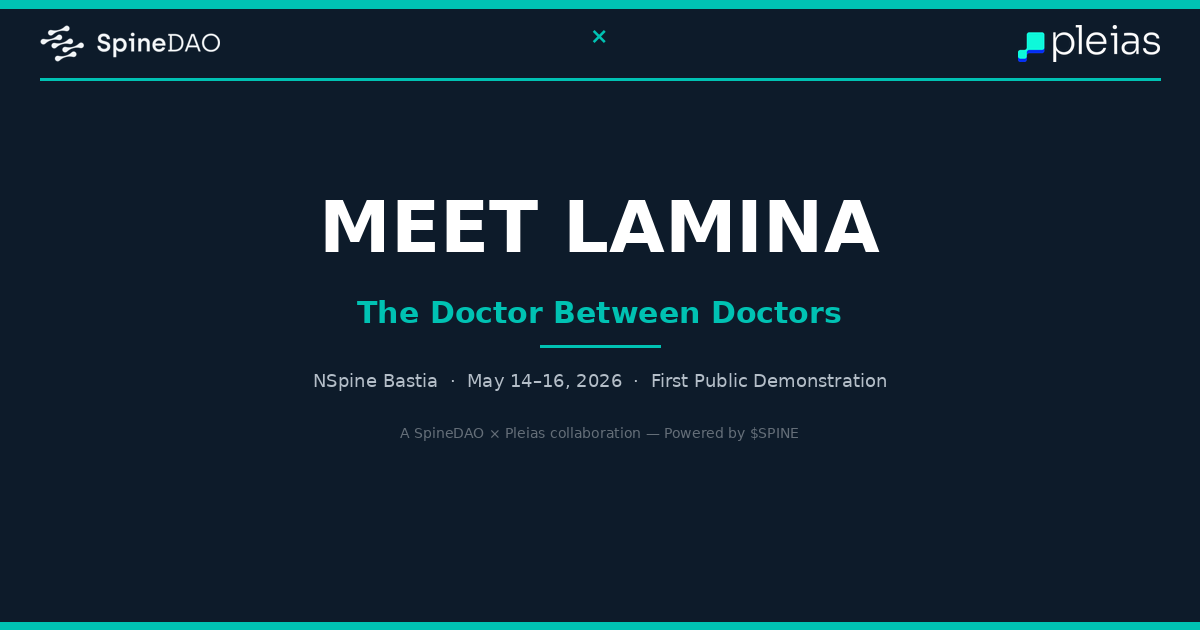
Meet Lamina: The Doctor Between Doctors
There is a moment every spine patient knows.
You leave your surgeon's office. You have a diagnosis, a prescription, and a follow-up appointment in three weeks. The door closes behind you.
And you are alone.
For the next 21 days, the questions multiply. What does this actually mean? Is this level of pain normal? Should I still be doing physiotherapy? Is something wrong?
You Google. You find contradictions. You end up more confused than when you left the clinic.
This is not a fringe experience. It is the default experience for 600 million people living with spinal conditions worldwide. The gap between appointments is where care breaks down — not in the clinic, but in the silence between visits.
The Intelligence Gap
The problem is not that the information doesn't exist. It does.
Your surgeon knows the answer to most of those questions. The clinical evidence exists. The treatment pathway is well understood.
The problem is that none of that knowledge can reach you between visits.
That is the gap Lamina was built to close.
What Lamina Is
Lamina is an AI clinical companion for spine patients — the doctor between doctors.
It is not a chatbot that reads symptom sheets. It is not a generic wellness app. It is a structured clinical intelligence layer built on proprietary data that doesn't exist anywhere else: real multicenter outcomes from SpineBase, 500 clinical vignettes reviewed by 52 verified spine specialists across 7 countries, and a knowledge graph built with surgical precision.
Lamina knows who you are. It matches your profile against validated clinical pathways. It remembers your last appointment. It tracks your pain scores, your treatments, your progress — and it builds a clinical "backpack" that your surgeon can read in 30 seconds at your next visit.
Every response is grounded in evidence. Every red flag is escalated. Lamina never makes a medical claim — it is a wellness companion operating in the space between appointments, not in the exam room.
Built with Pleias
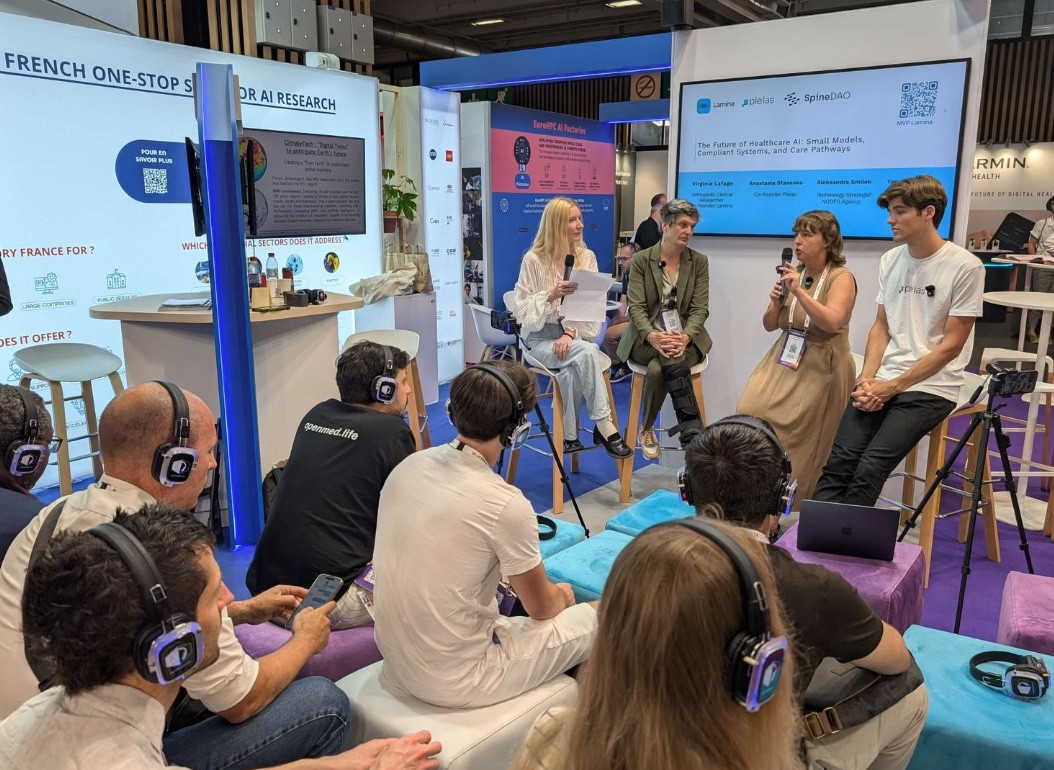
Lamina's AI infrastructure is developed in partnership with Pleias, a Paris-based AI company specializing in frugal, sovereign language models for regulated industries.
Pleias brings expertise in privacy-preserving AI architectures built for healthcare compliance — GDPR, HIPAA, EU AI Act. Their approach: small, specialized models (350M to 12B parameters) that run entirely on SpineDAO's infrastructure. No patient data leaves the controlled environment during processing or inference.
This is not a thin wrapper on a third-party API. Lamina's intelligence is built for spine — and owned by SpineDAO.
The Data Moat
Most AI products are prompts layered on a generalist model. The gap between "AI assistant" and "clinically useful AI" is large.
Lamina is different because its intelligence comes from the environment it runs in.
The same clinical vignettes reviewed by 52 specialists — the foundation of Spine Reviews, the first published DLT-based clinical knowledge crowdsourcing study — are the same vignettes that test and refine Lamina's responses. The synthetic patient personas used to benchmark Lamina are grounded in SpineDAO's certified synthetic registry data, validated against real multicenter outcomes.
Every patient interaction becomes a versioned clinical trajectory. Every session improves the system. The environment that generates the training data is the moat that generalist models cannot replicate.
In twelve months, Lamina will not be competing with frontier models on their benchmarks. It will outperform them on the only benchmarks that matter to a spine patient.
Demonstrated for the First Time at NSpine Bastia — May 14–16
Lamina makes its first public demonstration at the NSpine Southern European Summit in Bastia, Corsica, presented by Dr. Virginie Lafage (Lenox Hill Hospital, New York) — whose team presented the first peer-reviewed DLT paper in spine surgery at IMAST 2026 just weeks ago.
The demonstration will show:
- Clinical triage — routing a patient to the right pathway in real time
- Agentic chat — a free-form conversation where the AI knows your full clinical context
- The living profile — a patient record that builds itself from conversation
- The clinical backpack — a structured summary for the next consultation
Follow the Build
SpineDAO — Building Intelligence Around Spine Care









%20Medium.png)


.png)
