
SpineDAO Q2 2026 Progress Report

From a national congress award to a VivaTech stage — Q2 2026 moved SpineDAO from infrastructure to output across all four verticals.
Q2 2026 was defined by four major milestones: a national congress award for VECTOR, a stage-setting appearance at VivaTech for Lamina, the continued growth of SpineBase beyond 766 registered patients, and the public launch of our Track 2 radicular drug discovery program with PeptAI. Across all four verticals, the project is moving from infrastructure-building toward tangible clinical and scientific output.
This report covers progress across SPINAL/SPINEBASE, VECTOR, LAMINA, and TUYOUYOU — as well as the TLIF-BAYES multicentric retrospective dataset and ecosystem markers. It is addressed to contributors, collaborators, and the broader SpineDAO community.
1. SPINAL / SPINEBASE — Data Registry & Clinical Network
SpineBase — spinebase.app
SpineBase is SpineDAO's core tokenized data registry. The registry crossed 766 enrolled patients across surgical arms in Q2 — a meaningful multicentric cohort supporting the TLIF-BAYES dataset and the broader AI/knowledge-graph layer.

The knowledge graph spans 8 node classes and 12 relationship types, with 6 SpineDAO-authored peer-reviewed papers wired in (JBJS 2024, Spine 2022, Spine J 2016, Lancet 2019, NASSJ 2024, Spine Deform 2025). This graph is the backbone of hypothesis generation within the Chronos pipeline and the registered data query layer.
"Ask Vincent" AI Research Agent — Live since April 13
"Ask Vincent" went live April 13, 2026 — an LLM-powered research assistant querying PubMed, medRxiv, clinical cases, the knowledge graph, and the registry simultaneously. Designed for spine surgeons who need answers fast, without leaving their workflow.
Synthetic Data Manuscript — In Submission
The synthetic data layer, built on a Gaussian copula approach and validated through a three-gate framework (fidelity · utility · privacy), has been submitted for peer review. This publication will be meaningful both for the scientific rigor of the registry and for the broader DeSci data-sharing model.
Spinal — spinal.science
Spinal is SpineDAO's credentialed clinical network — where verified surgeons and researchers share cases, discuss protocols, contribute to polls, and earn $SPINE for their contributions.
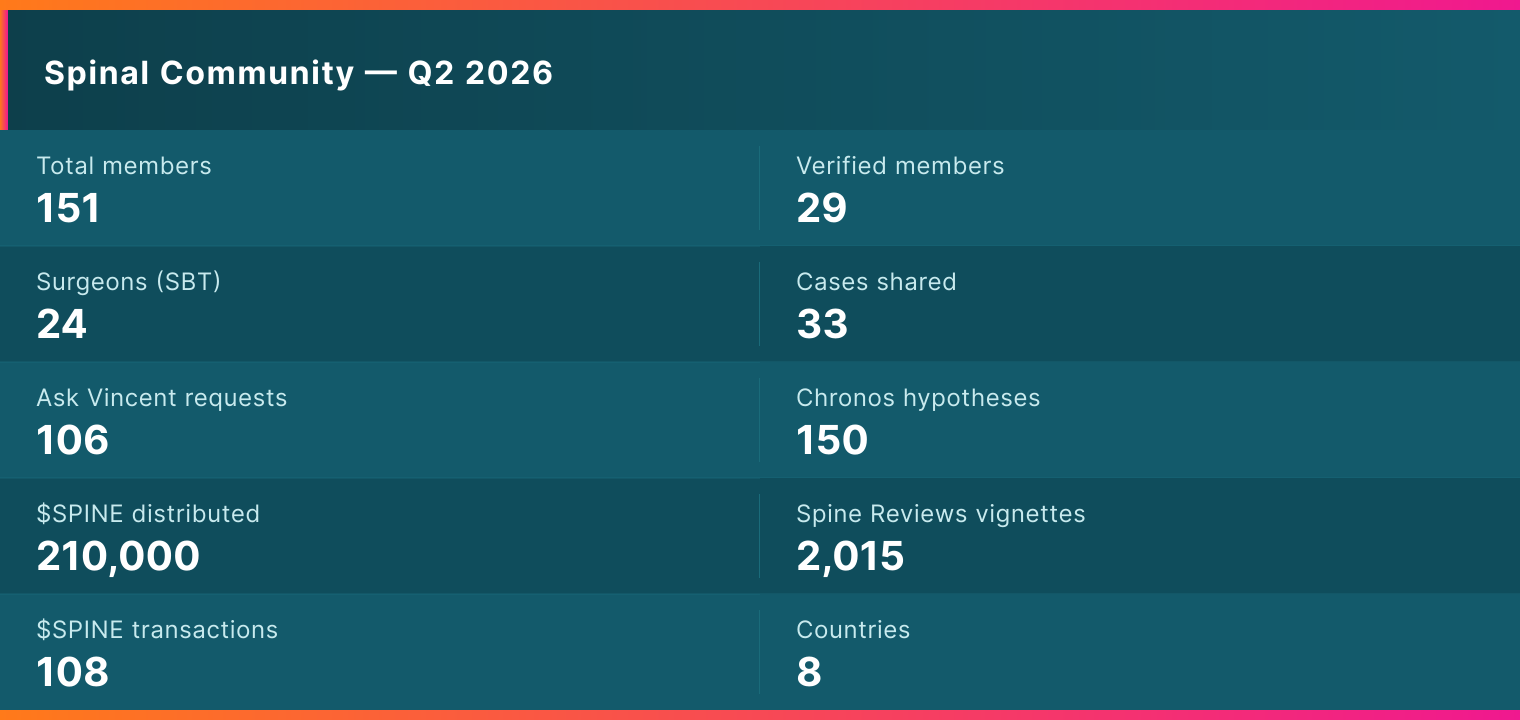
Platform highlights this quarter:
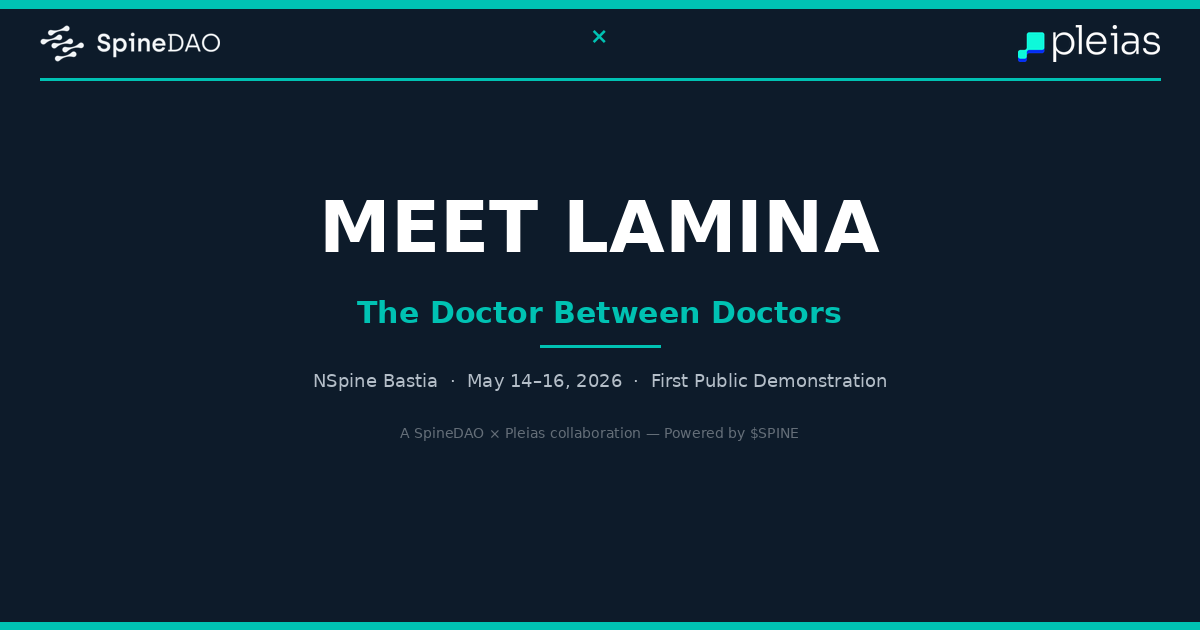
● NSpine Bastia (May2026): Spinal.sciencewas showcased to the French-speaking spine surgery community at the nationalNSpine congress in Bastia.
● Chronos recovery: Temporary service interruption dueto upload failures was diagnosed and resolved. Chronos is fully operational asof June 2026, with 150 hypotheses generated to date.
● iOS TestFlight: Mobile app available on TestFlight.Token/crypto features are intentionally excluded from the mobile build for AppStore compliance.
● 6 subspecialtycircles: Endoscopy· MIS · Adult Deformity · Pediatric Scoliosis · Trauma · Tumor — active andgrowing. UI refinements in progress
Blockchain status — honest summary (June 2026):
● ✓ $SPINE token: live and trading (Raydium/Jupiter)
● ✓ Squads treasury: operational — 509.7M SPINE across 8 multisig buckets (~51% of supply)
● ✓ Surgeon SBT credentials: 29 minted (Metaplex, non-transferable)
● ✓ Live $SPINE transfers to surgeon wallets: active
● ✓ data_contribution Anchor program: deployed on Solana mainnet
● ○ On-chain reward calculation contract: server-side for now → H2 2026
● ○ DAO governance on-chain: Q4 2026 target (Realms / SPL Governance)
2. VECTOR — AI Patient Prioritisation
VECTOR is the AI-driven patient prioritisation tool for spine care — helping clinicians identify early which patients are likely to need surgery and which are not. The algorithm analyses questionnaire and clinical-exam data to generate a risk/priority score, while keeping full decision authority with the clinician.
"The right patient, for the right specialist, at the right time."
SFCR 2026 — 2nd Prize, Best Scientific Communication
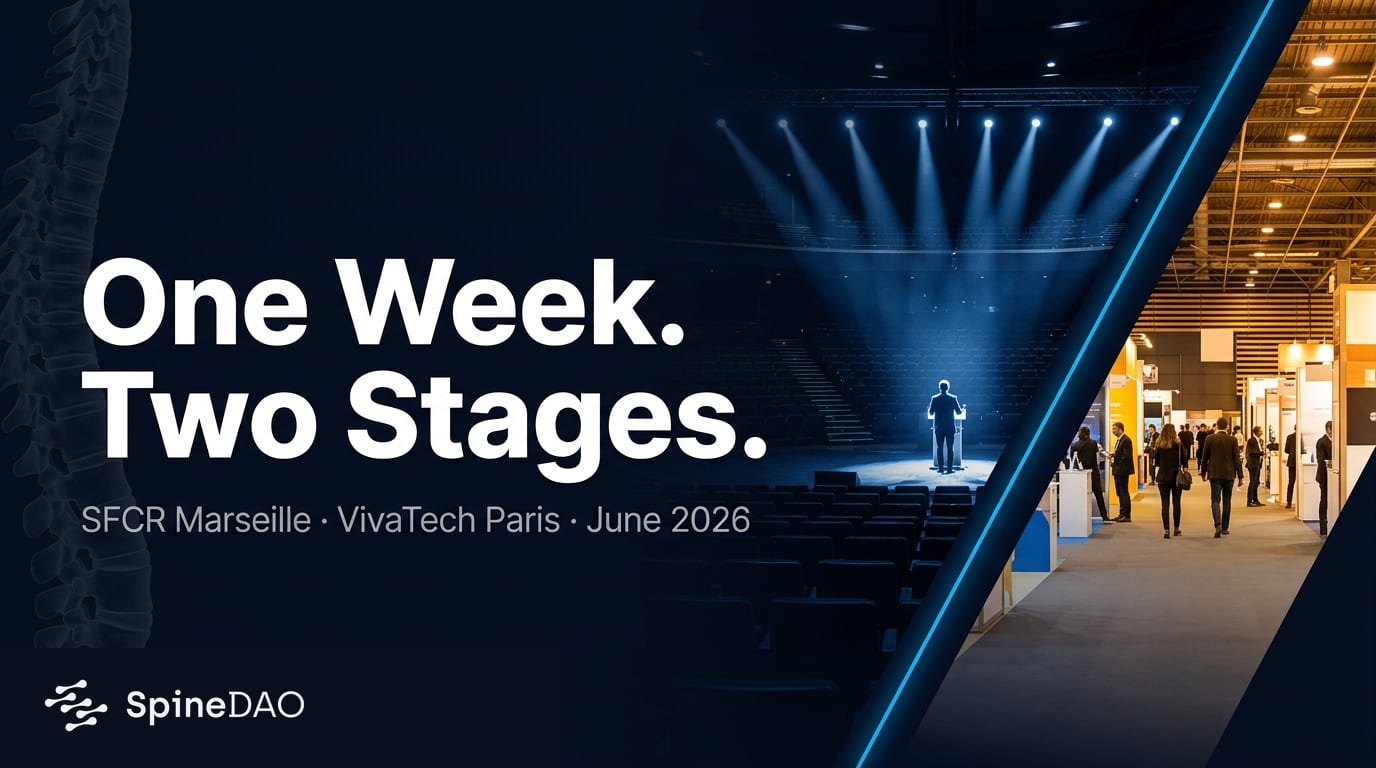
The defining Q2 moment for VECTOR: at the SFCR 2026 national congress (Société Française de Chirurgie Rachidienne, Palais du Pharo, Marseille, June 11–13), VECTOR's clinical validation study was awarded 2nd Prize for Best Scientific Communication.
The work — "Évaluation prospective d'un outil algorithmique d'optimisation des délais de rendez-vous" — was presented by Guillaume Lonjon, MD PhD (OrthoSud, ESUBE), with co-authors Vincent Challier, Joseph Cristini, Matthieu Vassal, Alexandre Dhenin, Alexis Perez, Jonathan Lebhar, Thomas Chevillotte, Aurore Sellier, Sébastien Trincat, and F.-X. Ferracci. Partners credited on slide: OrthoSud Montpellier · CSR · ESUBE · SpineDAO.
Guillaume Lonjon's LinkedIn post generated 243+ reactions and significant engagement — clear signal of clinical community interest in early AI-driven prioritisation.
Validation & Commercialisation
● Study: Multicenter prospective, France — 500patients
● Ethics: IRB-SOFCOT Ref. 21-2025 · EthicsCommittee approved · GDPR + EU healthcare research standards
● Next step: Results to inform EU MDRcertification pathway in 2026
● Commercialisation target: 2026 — hospitals,clinics, insurers. Demo request pipeline live at vector-med.ai
3. LAMINA — AI Patient Companion
Lamina is the AI clinical companion for spine patients — "the doctor between doctors." It closes the care gap between appointments: guided intake, condition tracking between visits, safety-screened conversation, and a living patient profile built over time. Co-founded by Virginie Lafage PhD (orthopedic clinical researcher) with AI partner pleias (Anastasia Stasenko, CEO · Yannick Detrois, AI Scientist).
VivaTech 2026 — Paris, June 19
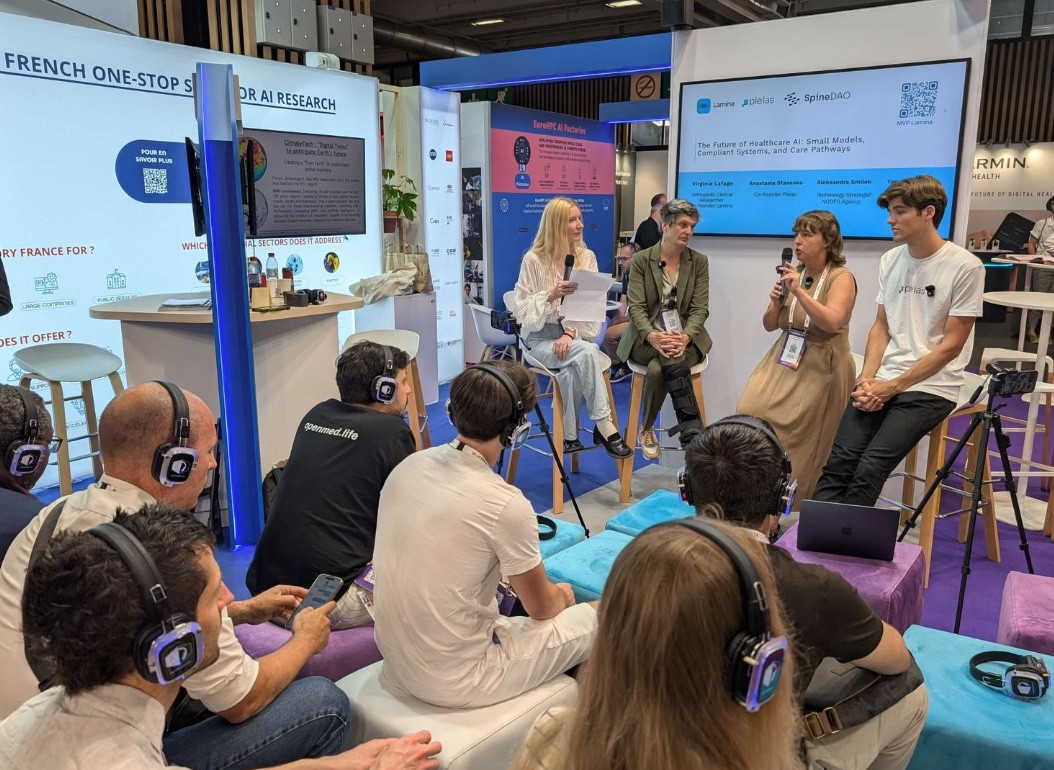
Lamina made its European stage debut at VivaTech 2026 (Paris, June 17–20) in the session "The Future of Healthcare AI: Small Models, Compliant Systems, and Care Pathways" at the AI Factory France stand. The panel — hosted by Aleksandra Smilek — brought together Virginie Lafage, Anastasia Stasenko, and Yannick Detrois, presenting a clear clinical AI thesis:
● Small, open, auditable models canoutperform large frontier models in clinical settings
● Deterministic clinical logic keeps apatient-facing tool trustworthy — beneath free-form conversation
● An open stack can satisfy both HIPAAand GDPR simultaneously
● AI eases strained care pathwayswithout displacing the clinician
Product Status & Four Features
Lamina is in late Beta, transitioning to MVP hardening. Priority is production-readiness, trust, and compliance — not new features. Clinic and hospital deployment is on the near-term roadmap.
● Triage & Referral— Guided intakewith red-flag screening from clinical guidelines; routes patients to the rightcare pathway. "Safe by design, from the first message."
● Follow-up &Consultation Companion — Tracks condition between visits; delivers a structured clinical summaryat the next appointment. "Care that doesn't stop at the clinicdoor."
● Agentic Chat — Intent-aware clinical agent — not ageneric chatbot. Every interaction is safety-screened and routed appropriately."A conversation that understands spine care."
● Living Profile — Patient's personal clinical timelineand knowledge base, built interaction by interaction. "Watch Laminaget smarter about you."
TechnicalFoundation
● Validated clinical instrumentation: ODI, STarT Back, yellow-flag/red-flag detectors, triage orchestrator
● Compliance by design: open,auditable architecture satisfying HIPAA + GDPR
● Evidence-grounded: responsesanchored in scientific literature + clinical vignette corpus
4. TUYOUYOU — Drug Discovery Engine
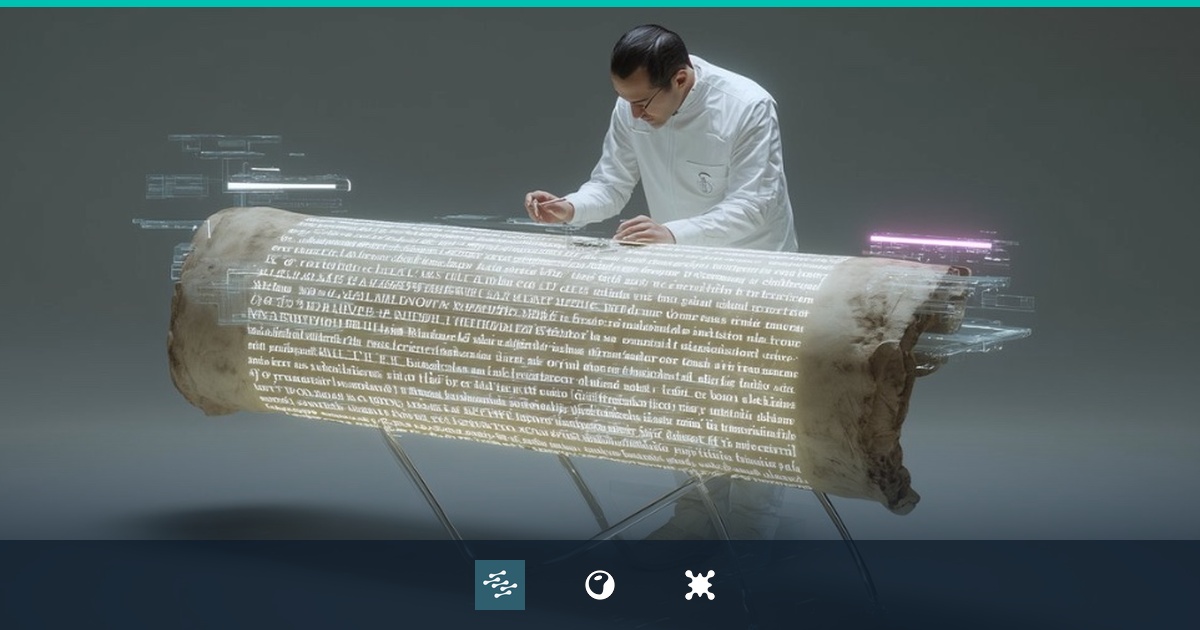
TUYOUYOU is SpineDAO's AI-powered drug discovery engine — named for Tu Youyou's Nobel Prize-winning project that systematically mined historical texts and rediscovered artemisinin. We are applying the same principle to spine: mining neglected sources, generating AI hypotheses, and advancing verified candidates through a computational-to-wet-lab pipeline.
Pipeline
SpineQuest → Chronos → BIOS → PeptAI → Molecule
● SpineQuest: Crowdsourced upload of historicaland traditional spine-medicine manuscripts as source material
● Chronos: AI knowledge-graph hypothesis engine— preprint published; 150 hypotheses generated to date
● BIOS: Autonomous AI-Scientist forhypothesis ranking and validation pathway design
● PeptAI: AI molecule/peptide design + wet-labCRO execution (Rafael Rolli)
● Molecule.xyz: Verifiable IP provenance andlicensing for confirmed candidates
Track 2 — Radicular Program (Active, Public)
The public program targets lumbosacral radiculopathy (sciatica) with a non-sedating peptide analgesic. Gabapentinoids failed vs. placebo (PRECISE, NEJM 2017) and carry sedation and dependence liabilities. No differentiated non-opioid currently owns this space. Market size: ~$8–10B today, projected ~$16–18B by mid-2030s
● Mechanism: Engineered developable analogs ofthe published, in-vivo-validated α2δ-1 decoypeptide (Chen et al., 2018) — refining known biology, not de-novo speculation
● Collaboration: PeptAI partnership confirmed withRafael Rolli — analog engineering pipeline active
● Next stage: Computational candidate library →in-vitro target engagement → in-vivo efficacy/tolerability vs. gabapentinoid
Publicprogram: openlabs.bio.xyz · IP registration: molecule.xyz
Engineered analog sequences remain internal pending deliberate file-or-publish decisionsper candidate — consistent with EU absolute novelty requirements.
5. TLIF-BAYES — Multicentric Retrospective Dataset
The TLIF-BAYES study is a multicentric retrospective dataset comparing Open TLIF vs MIS-TLIF vs Endoscopic TLIF, with revision surgery as the primary outcome (9-code cause taxonomy). Bayesian hierarchical modelling is applied to the growing real-world registry — one of the most rigorous analytical frameworks SpineDAO has engaged to date.
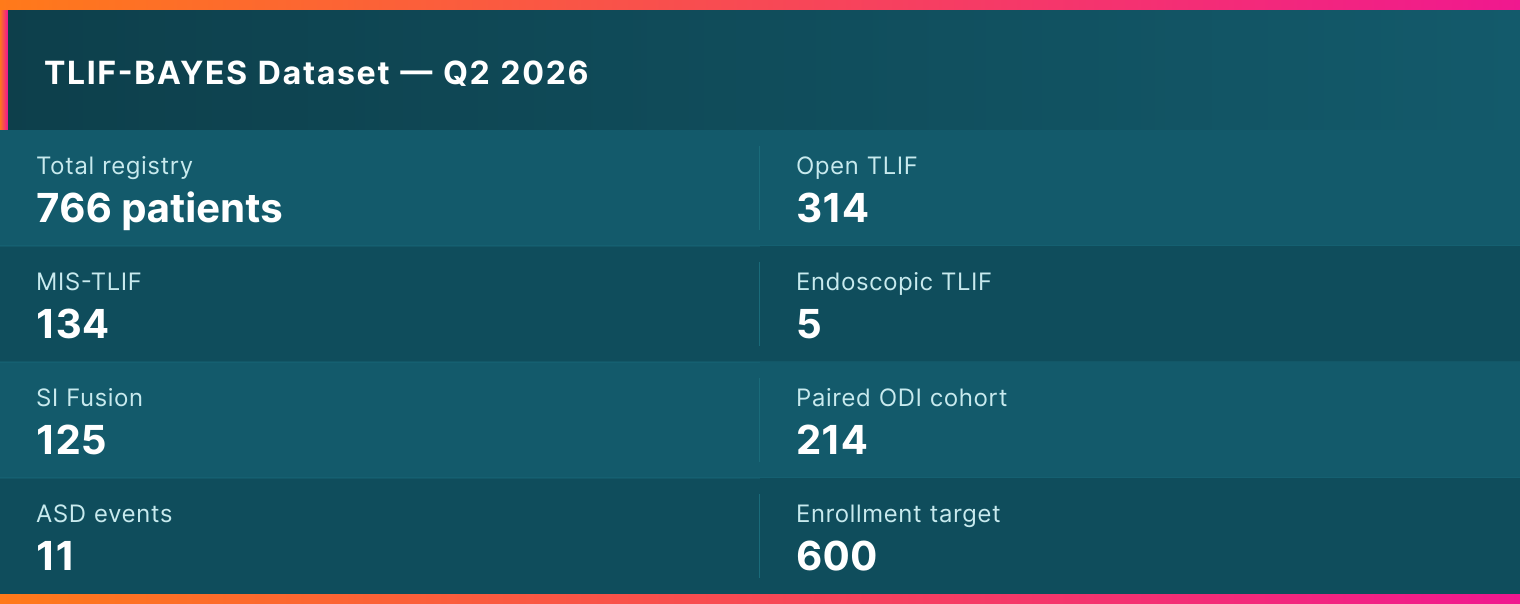
● PI: Dr. Anton Denisov, MD (Russia/Spain)— verified on Spinal, March 2026
● Sponsor: SpineDAO
● Framework: R + Stan (brms) · Bayesianhierarchical modeling · prior informed by PI's 2026 meta-analysis
● Regulatory: Hors loi Jardé · Hors RGPD(anonymised) · DPO notification only
● SRC: 13 co-investigators contributingacross centers
First interim Bayesian model run planned at 400+ patients enrolled across primary arms.
6. Looking Ahead — H2 2026 Priorities
Research & Platform
● SpineBase: upload deduplication fix(data integrity pipeline)
● TLIF-BAYES: first Bayesian model runat 400+ patients
● Synthetic data manuscript: peerreview outcome
● Track 2 Radicular: computationalcandidates → in-vitro stage
Products & Validation
● VECTOR: complete website fixes, then commercialisation push with hospital/clinic demos
● VECTOR: EU MDR certification —500-patient study results to inform pathway
● Lamina: MVP hardening complete →first clinic deployments
● Spinal:on-chain reward calculation smart contract (H2 2026)
● Spinal: Circles UI fix and continuedmember onboarding
Governance & Ecosystem
● Squads treasury top-up vote (hotwallet operational continuity)
● DAO governance on-chain: Q4 2026(Realms / SPL Governance)
● Communityvotes: IOU model, contributor points conversion ratio
Closing Note
Q2 2026 demonstrated that the SpineDAO thesis is executable. A clinical AI tool won a national award. A patient companion was presented at VivaTech. The registry passed 766 patients. A drug discovery collaboration reached the analog-engineering stage. The clinical network is growing with real verified surgeons doing real science together.
The next 90 days are about consolidation — fixing the infrastructure that enables scale, advancing the clinical validation that unlocks commercialisation, and keeping the science honest about what it is and is not yet.
If you are a clinician, researcher, or contributor interested in what SpineDAO is building — reach out. The platform is live, the data is growing, and the science is real.





%20Medium.png)


.png)
