Lamina at VivaTech: The Doctor Between Doctors, Built on Small Models

Jun 28, 2026
VivaTech 2026 — The Future of Healthcare AI: Small Models, Compliant Systems, and Care Pathways

A clinician-led AI partnership targeting the gap where patients need help most: between appointments.

A spine patient leaves the consultation room with a diagnosis, a treatment plan, and a hundred questions they forgot to ask. Between that moment and their next appointment, they navigate alone — searching symptoms online, reading contradictory forum posts, unsure whether their pain is recovery or progression. Clinicians have a word for it: errance — the wandering from specialist to specialist, the silence between appointments that costs patients and health systems far too much.

Lamina exists to close that gap.

A Clinician-Led Partnership

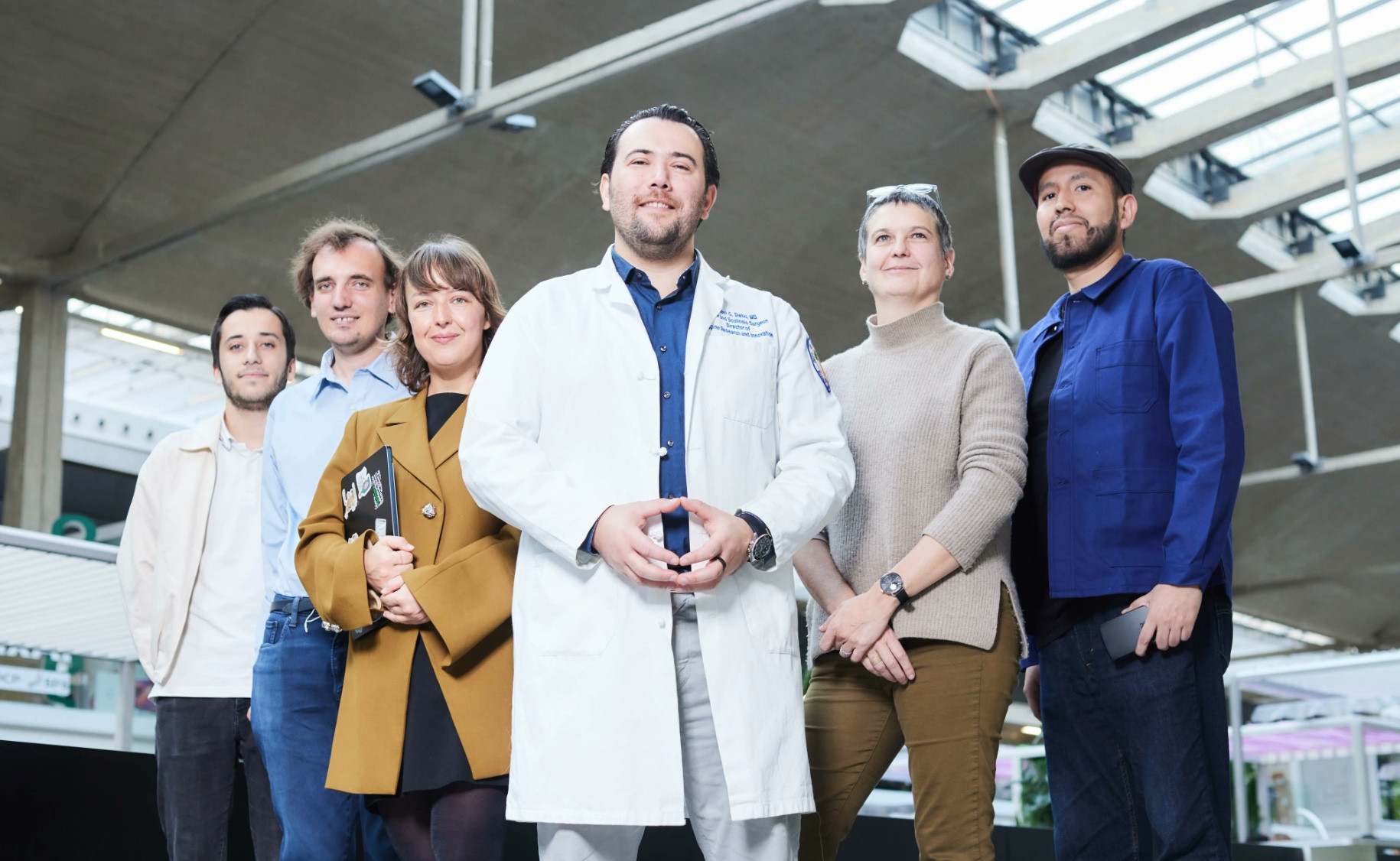
SpineDAO and pleias team at Station F, Paris — December 2025
The SpineDAO × pleias team at Station F, Europe's largest incubator — December 2025

Lamina is built by two teams with a shared conviction: most medical AI is built wrong. SpineDAO, a research collective of spine clinicians, scientists, and engineers, partnered with pleias, an open AI company building specialised language models around compliance, transparency, and European data sovereignty.

Lamina was designed to be different from day one: clinician-led, co-founded by orthopaedic clinical researcher Virginie Lafage, PhD; built on open, auditable models; and organised around clinical pathways rather than chat sessions.

VivaTech 2026: Small Models, Compliant Systems, Care Pathways

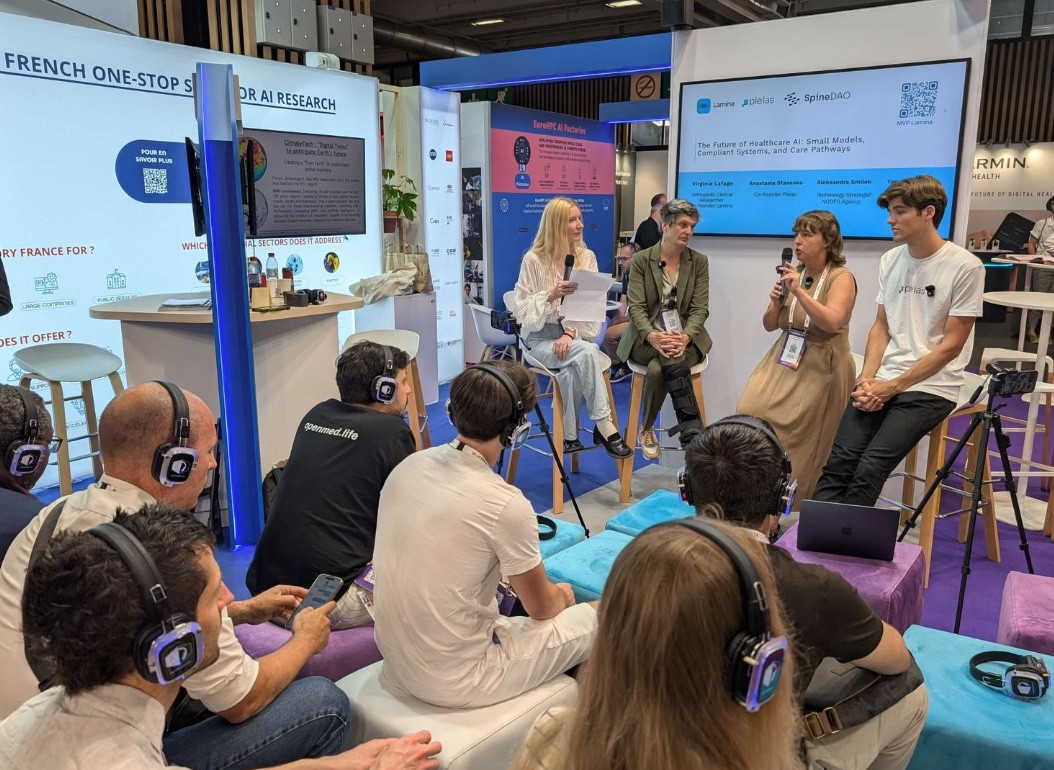
VivaTech 2026, Paris — Aleksandra Smilek hosts Virginie Lafage, Anastasia Stasenko, and Yannick Detrois at the AI Factory France stage, 19 June 2026

June 19, Paris. At the AI Factory France stage, Aleksandra Smilek hosted a conversation that cut through a week dominated by large-model benchmarks with a quieter, harder question: what does it actually take to deploy AI safely inside a clinical care pathway?

Virginie Lafage (Orthopaedic Clinical Researcher, co-founder of Lamina), Anastasia Stasenko (CEO, pleias), and Yannick Detrois (AI Scientist, pleias) gave three versions of the same answer. Small, open, and auditable models are not a compromise — they are a deliberate design choice that makes compliance tractable, data governance real, and clinical trust earnable.

For Lamina, that is not a theoretical position. It is a live architecture.

Why a Chatbot Is Not Enough

Most patient-facing medical AI is a chatbox with a disclaimer at the bottom. It can discuss anything. It has no concept of triage. It does not know when to reassure and when to escalate, and it forgets every conversation the moment it ends.

Lamina is built differently. Deterministic clinical logic governs onboarding, triage, and red-flag screening. Validated clinical instruments — the Oswestry Disability Index, STarT Back, and yellow- and red-flag detectors — run behind a conversational interface that feels natural but is, beneath the surface, structured. Context persists across appointments, and at the next visit the clinician receives a structured summary of what happened in the gap.

That is what pathways means in practice: not a workflow diagram, but a system that holds state across the silence between appointments — and returns something useful to the clinical team.

Inside the Architecture

Lamina is built with pleias on compact, open models trained entirely on documented open datasets — many produced on Jean-Zay, France's national supercomputer operated by GENCI and IDRIS. No patient data leaves controlled environments.

Both evaluation and generation draw on the Nemotron Personas series — statistically grounded synthetic persona datasets covering France, Belgium, and the United States, produced by pleias in collaboration with NVIDIA. For Lamina, the personas serve two purposes.

First, evaluation: testing model behaviour across the full demographic spectrum of patients the system will actually encounter — region by region and profile by profile — rather than a notional average user: the patient in Eupen whose home language is German, the Francophone patient in Liège, the Brussels professional who moves between both.

Second, generation: expanding a limited seed of real cases into demographically coherent synthetic populations — intake notes, clinical conversations, follow-ups — that reflect the genuine diversity a spine clinic sees.

"Better grounded data is what makes a small efficient regional-specific model viable in the first place." — pleias

The result is built for HIPAA and GDPR compliance, auditable end-to-end, and able to operate within the trust and cost constraints of a real clinical deployment.

What Comes Next

Lamina is heading into clinics and hospitals. The beta is being hardened ahead of first deployments — beginning precisely where the system can help patients most: in the gap between the consultation room and the next appointment.

If you are a clinician, healthcare institution, or partner organisation interested in what a properly built clinical AI pathway looks like in practice, we'd like to hear from you.

Follow SpineDAO

More from the SpineDAO Blog

VivaTech 2026 — The Future of Healthcare AI: Small Models, Compliant Systems, and Care Pathways

Lamina at VivaTech: The Doctor Between Doctors, Built on Small Models
Jun 28, 2026
How Lamina and pleias are closing the silence between appointments — clinician-led, open models, care pathways over chatbots. Presented at VivaTech 2026.
Read More

One Week. Two Stages. A Turning Point for Clinician-Built AI.

Jun 19, 2026
In one week: Virginie Lafage opened the SFCR national congress in Marseille, Guillaume Lonjon won 2nd Prize for VECTOR, and Lamina took the stage at VivaTech Paris. Here is what happened.
Read More
SpineDAO Chronos BIOS PeptAI Discovery Pipeline

From Tu Youyou to a Validated Target in a Single Working Session

May 30, 2026
How SpineDAO built an open, on-chain pipeline that turns centuries of forgotten medicine into testable hypotheses and validated drug targets — and the community that feeds it.
Read More
NSpine Bastia 2026 — Southern European Spine Summit, Corsica

Notes from Bastia — Part 1: Where Surgical Foundations Meet Decentralized Science

May 17, 2026
A field report from the NSpine Southern European Spine Summit 2026. Day 1 degenerative plenary: ALIF for sagittal balance, UBE TLIF adoption, endoscopic decompression vs fusion, and SpineDAO’s first podium appearance.
Read More
TLIF spine surgery illustration

TLIF: A Guide to One of Modern Spine Surgery's Most Established Techniques

May 13, 2026
From open surgery to endoscopy — the complete guide to TLIF. History, three technique variants, the Denisov 2026 meta-analysis, and the TLIF-BAYES patient-specific risk prediction study.
Read More
Meet Lamina - SpineDAO x Pleias

Meet Lamina: The Doctor Between Doctors

May 9, 2026
SpineDAO's AI clinical companion makes its first public demonstration at NSpine Bastia, May 14-16. Built with Pleias. Powered by $SPINE.
Read More
SpineDAO Complete Data Pipeline

We Made 10,000 Spine Surgery Patients That Don't Exist. Then We Built an AI From the Answers.

Apr 7, 2026
The complete SpineDAO pipeline: real patient data to certified synthetic twins to expert labels to AI product — entirely on-chain.
Read More
The Collective Intelligence Layer for Spine Surgery Is Live — Vincent's Blog

The Collective Intelligence Layer for Spine Surgery Is Live

Mar 30, 2026
370 patients. 57 clinical concepts. Three intelligence layers. One query. Here is the first finding from SpineDAO collective intelligence layer for spine surgery.
Read More
SpineDAO Q1 2026 Community Updates

SpineDAO Q1 2026 — Progress Report & Roadmap

Mar 26, 2026
Nearly a year into our journey, SpineDAO has moved from token launch to a live, production-grade tokenized clinical data platform — with real $SPINE flowing to real surgeon wallets on Solana mainnet.
Read More

From Passive Patient to Informed Partner: Strategic Priorities for the Next Era of Healthcare

Aug 15, 2025
In 2025, patient expectations are shifting fast. This report explores how agency, informed decision-making, specialized AI, and strong doctor–patient trust are redefining recovery, loyalty, and the future of healthcare.
Read More

COMMUNITY BOUNTY - Patient Story Podcast

Jul 31, 2025
🎙 Calling All AMA Creators! Are you passionate about DeSci, AI in healthcare, and creating content that makes a difference? We’re offering bounty for podcast creators to host a podcast featuring 2 patients in conversation with our experts.
Read More

Tokenizing Expertise: Rewarding Clinicians with $SPINE for Data Labeling

Jul 18, 2025
SpineDAO has launched the first AI healthcare labeling platform that rewards highly trained spine clinicians around the world with tokens.
Read More

SpineDAO Community Updates: June 2025

Jun 18, 2025
From launching the Spindiana quest to partnering to bring GDPR-Compliant solutions to Europe, SpineDAO has made great strides in the past few weeks Post-TGE
Read More

SpineDAO Ecosystem Report: April 2025

May 12, 2025
SpineDAO’s April 2025 recap: Over $200K raised on Solana, major product milestones, new AI challenges, and historic partnerships—advancing decentralized spine healthcare.
Read More

Blockchain Technology is the Guardian of AI

May 2, 2025
A thought-leadership post by Dr. Vincent Challier, spine surgeon and SpineDAO Founder, on why Web3 and AI are key to securing and validating healthcare data.
Read More

How to Participate in the SPINE Token Auction

Apr 16, 2025
Get SPINE tokens on Bio Protocol's new V1 launchpad with SOL tokens in three simple steps.
Read More

SpineDAO Quarterly Report: Q1 2025

Apr 2, 2025
SpineDAO’s Q1 2025 was packed with milestones and high momentum—community growth, key partnerships, product progress, and the $SPINE token launch. Dive into the full recap and what’s next!
Read More

How to Get SPINE Tokens in the Community Sale

Feb 22, 2025
Learn how to participate in the SPINE token community sale with this step-by-step guide. Exchange BIO and SOL for SPINE, set up your Phantom Wallet, and secure your tokens safely on the Solana blockchain.
Read More

The Critical Role of Triage in Addressing the Burden of Non-Surgical Candidates

Jan 13, 2025
Here’s why SpineDAO is building more efficient spine care triage pathways.
Read More

How Wait Times Affect Spine Surgery Outcomes

Jan 7, 2025
Discover how SpineDAO is leveraging innovative triage systems, predictive algorithms, and data-driven tools to reduce delays and improve surgical success.
Read More

Our Value Capture Model: Pioneering a New Era in Spine Care

Jan 6, 2025
Discover how Spine DAO’s innovative value capture model is transforming spine care through data monetization, IP tokenization, decentralized publishing, and strategic partnerships.
Read More

Introducing SpineDAO

Jan 4, 2025
We’re looking to change back stories, so we started the first surgical DAO created to improve spine care by leveraging blockchain, AI, and tokenized incentives.
Read More

Cracking the Spine Care Market: A Deep Dive into a Complex Industry

Mar 13, 2025
With millions affected, the demand for spine care solutions has skyrocketed. But just how big is the spine care industry?
Read More